3 Quick Workouts for Busy People (Under 15 Minutes)
Let’s be honest—you’ve probably scrolled past countless fitness posts promising transformation with minimal effort. But here’s the truth: you don’t need a 60-minute gym session to get real results.
That’s not just motivational fluff; it’s backed by research showing that short, focused workouts can deliver the same benefits as longer sessions when done correctly.
The problem isn’t your schedule—it’s the outdated belief that effective workouts demand hours of your time. Whether you’re juggling work meetings, family obligations, or just trying to maintain some semblance of work-life balance, these three proven workout routines will fit seamlessly into your life. Each takes 15 minutes or less, requires zero equipment, and delivers measurable results.
You’ll discover a high-intensity circuit that torches calories, a mobility flow that eliminates desk-job stiffness, and a strength routine that builds lean muscle without stepping foot in a gym. Perfect for busy mornings before the chaos begins, quick lunch breaks when you need an energy boost, or evening wind-downs to unwind after a long day.
No fancy equipment. No gym membership. No excuses. Just you, your determination, and a commitment to 10-15 minutes. Ready to prove that busy people can be fit people? Let’s dive in.
The Ultimate 15-Minute Full-Body HIIT Workout

What Makes This Workout Amazing
High-Intensity Interval Training isn’t just another fitness trend—it’s a scientifically proven method that burns more calories in 15 minutes than 30 minutes of steady-state cardio.
The secret lies in the afterburn effect, where your metabolism stays elevated for up to 24 hours after you finish. That means you’re burning calories while answering emails, sitting in meetings, or sleeping.
This workout requires nothing but your body weight, making it perfect for hotel rooms, living rooms, or even your office if you’re brave enough.
The beauty of HIIT is its adaptability—every exercise can be modified to match your current fitness level. Beginners can step back instead of jumping, while advanced exercisers can push harder during each interval.
Studies show that just three 15-minute HIIT sessions per week can improve cardiovascular health, increase endurance, and reduce body fat more effectively than traditional moderate-intensity exercise. The key is maintaining that high intensity during work periods—you should feel challenged, not comfortable.
The Complete 15-Minute Routine
Start with a 2-minute warm-up to prepare your body and prevent injury. Begin with 30 seconds of jumping jacks to elevate your heart rate, followed by 30 seconds of arm circles (forward and backward) to loosen your shoulders.
Spend the final minute on leg swings—hold a wall for balance and swing each leg forward and back, then side to side. This simple warm-up increases blood flow and activates the muscles you’re about to challenge.
Now comes the 10-minute circuit—the heart of this workout. Set a timer for 40 seconds of work followed by 20 seconds of rest. You’ll cycle through six exercises twice, providing a complete full-body workout.
Burpees (or modified step-backs for beginners): Drop your hands to the floor, jump or step your feet back to plank position, perform a push-up if you can, then jump or step your feet forward and stand up. This exercise engages every major muscle group while spiking your heart rate.
Mountain climbers: Start in plank position and alternate driving your knees toward your chest as quickly as possible while maintaining a strong core. This targets your abs, shoulders, and hip flexors while keeping your heart pumping.
Squat jumps (or regular squats): Lower into a squat with your weight in your heels, then explosively jump up. Land softly and immediately lower into the next squat. If jumping feels too intense, perform regular bodyweight squats with controlled movement.
Push-ups: Choose your variation—full push-ups, knees-down push-ups, or wall push-ups. Focus on maintaining a straight line from head to heels and lowering your chest toward the floor with control.
High knees: Run in place while driving your knees up toward your chest as high as possible. Pump your arms to increase intensity and maintain a quick pace.
Plank hold: Hold a strong plank position with your forearms on the ground, body in a straight line, and core engaged. Don’t let your hips sag or pike upward.
After completing this circuit twice, finish with a 3-minute cool-down. Spend 30 seconds on each stretch: standing quad stretch, forward fold for hamstrings, chest opener with hands clasped behind your back, and a figure-four stretch for your glutes. End with deep breathing to bring your heart rate down gradually.
Pro Tips for Maximum Results
Form always trumps speed. Rushing through sloppy reps increases injury risk and decreases effectiveness. If you feel your form breaking down during the 40-second work period, slow down or take a brief pause. Quality reps build strength; rushed reps build frustration.
Keep a water bottle within arm’s reach. You’ll be sweating, and staying hydrated helps maintain performance and aids recovery. Take small sips during your 20-second rest periods.
Track your progress weekly to stay motivated. Note how many reps you complete during each 40-second interval or how the exercises feel. You’ll be amazed at how quickly your endurance improves when you see tangible progress.
Timing matters for maximum benefit. Morning workouts jumpstart your metabolism for the entire day, giving you sustained energy and mental clarity. Pre-dinner workouts are also effective, helping regulate appetite and providing a clear transition from work mode to evening relaxation.
The Essential 10-Minute Morning Mobility Flow

Why Mobility Matters for Busy People
If you spend most of your day sitting at a desk, hunched over a computer, or trapped in your car during commutes, your body is silently screaming for movement.
Mobility work isn’t just for athletes—it’s essential for anyone who wants to move through daily life without stiffness, pain, or limitation.
Regular mobility practice reduces the chronic stiffness that comes from prolonged sitting. It counteracts the forward-rounded posture that leads to shoulder pain, improves hip flexibility that prevents lower back issues, and maintains the range of motion you need for everyday activities like reaching overhead or bending down.
Beyond the physical benefits, this 10-minute flow creates a calming morning ritual that reduces stress before your day even begins. Starting your morning with intentional movement and deep breathing sets a positive tone, improving focus and emotional regulation throughout the day.
Research shows that daily mobility work prevents injury during both exercise and daily activities. When your joints move freely through their full range of motion, you’re less likely to strain muscles or stress connective tissues during sudden movements.
Your Simple 10-Minute Flow
Minutes 1-2: Spinal Mobility
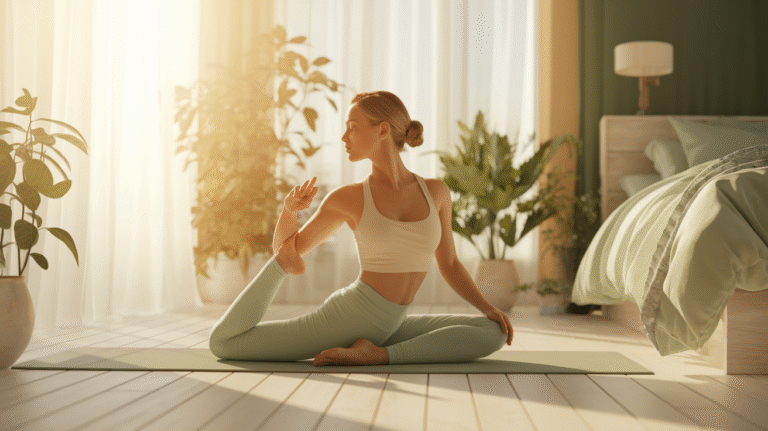
Begin in a tabletop position on your hands and knees (or do these in bed if you need extra motivation to start). Perform cat-cow stretches by arching your back and looking up (cow), then rounding your spine and tucking your chin (cat). Move slowly with your breath—inhale as you arch, exhale as you round. Do this for one minute.
Next, sit back on your heels and perform gentle spinal twists. Place your right hand on your left knee and twist your torso to the left, looking over your left shoulder. Hold for three breaths, then switch sides. Repeat twice on each side.
Minutes 3-4: Hip Opening
Stand up and place your hands on your hips. Make large, slow circles with your hips—five circles in each direction. This lubricates the hip joints and releases tension from sitting.
Follow with deep squats. Lower yourself into the deepest squat you can manage, keeping your heels on the ground if possible. Hold the bottom position and gently rock side to side, feeling the stretch in your inner thighs and hips. Stay here for 30 seconds, then stand and repeat once more.
Minutes 5-6: Upper Body Release
Perform shoulder rolls—lift your shoulders toward your ears, roll them back and down in large circles. Do ten forward circles, then ten backward circles. This releases neck and shoulder tension accumulated from computer work.
Extend your right arm across your body and use your left hand to gently pull it closer to your chest, feeling the stretch in your shoulder and upper back. Hold for 20 seconds, then switch arms. Repeat once on each side.
Minutes 7-8: Hamstring and Spine Lengthening
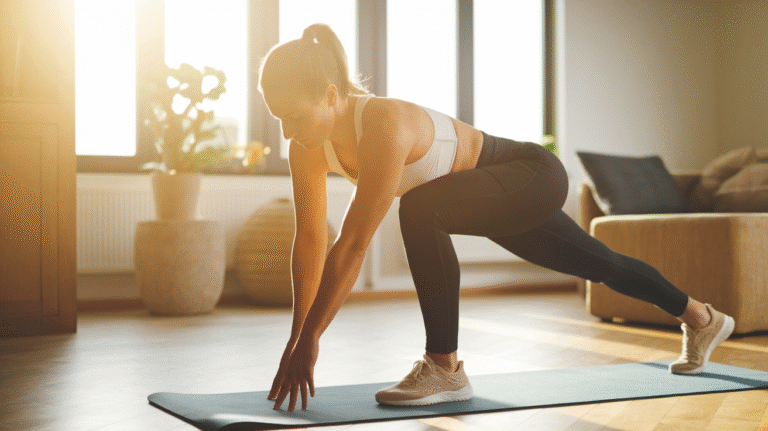
Stand with your feet hip-width apart and slowly fold forward from your hips, letting your upper body hang heavy. Bend your knees as much as needed—this isn’t about touching your toes; it’s about lengthening your spine and releasing your hamstrings. Gently sway side to side, letting gravity do the work. Stay here for one full minute, breathing deeply.
Slowly roll up to standing, one vertebra at a time, keeping your head as the last thing to lift. This protects your lower back and helps you feel the length you’ve created in your spine.
Minutes 9-10: Final Relaxation
Lower yourself to the floor and move into child’s pose. Sit back on your heels, extend your arms forward, and rest your forehead on the ground. This gentle position releases your lower back and creates space in your hips.
Finish with deep breathing exercises. Inhale through your nose for a count of four, hold for four, exhale through your mouth for six. Repeat this cycle five times. This activates your parasympathetic nervous system, leaving you calm and centered for the day ahead.
Making It a Daily Habit
The secret to consistency is removing decision-making from the equation. Do this flow immediately after waking up, before you check your phone or email. Your brain is still in a peaceful state, making it easier to focus on movement rather than your to-do list.
Pair this routine with your coffee brewing time. Start the coffee maker, then move through your flow while it brews. The time passes quickly, and you’re rewarded with both a mobile body and hot coffee.
You don’t need a dedicated yoga space or special equipment. Your bedroom floor works perfectly, or use a yoga mat if you have one. The low barrier to entry means you’re more likely to actually do it.
This flow is perfect for days when you need movement but not intensity. Maybe you did the HIIT workout yesterday and your muscles are tired, or perhaps you’re feeling stressed and need something gentle. Mobility work is exercise that feels like self-care.
Yes, you can absolutely do this in your pajamas. No need to change into workout clothes or feel like you need to “prepare” for exercise. Roll out of bed and start moving—it’s that simple.
The Proven 12-Minute Strength Builder (No Gym Required)
The Benefits of Quick Strength Training
Building strength isn’t just about aesthetics—it’s about creating a body that serves you well in daily life. Strength training builds lean muscle tissue, which increases your resting metabolic rate. That means you burn more calories throughout the day, even while sitting at your desk or watching TV.
Strong muscles support healthy bones. Weight-bearing exercises stimulate bone growth and increase bone density, reducing your risk of osteoporosis as you age. This matters whether you’re 25 or 65—bone health is a long-term investment.
Functional strength makes everyday activities easier and safer. Carrying groceries, lifting kids, moving furniture, climbing stairs—these movements become effortless when you regularly challenge your muscles. You’ll also notice improved balance and coordination, reducing fall risk.
Research consistently shows that strength training improves mental health. Regular resistance exercise reduces symptoms of anxiety and depression while boosting confidence and self-efficacy. There’s something powerful about knowing your body can handle physical challenges.
The Complete 12-Minute Strength Circuit
Begin with a 2-minute warm-up to prepare your muscles for work. Perform arm swings—extend your arms out to the sides and swing them forward in large circles, then backward. Follow with leg kicks—hold a wall for balance and kick each leg forward and back, loosening your hip flexors and hamstrings. Finish with 30 seconds of bodyweight squats, focusing on form and gradually increasing your range of motion.
The 9-minute strength circuit uses a 45-second work period with 15-second rest intervals. You’ll perform six exercises, cycling through the circuit one and a half times for complete muscle fatigue.
Push-ups: Choose the variation that allows you to maintain perfect form for the full 45 seconds. Full push-ups challenge your chest, shoulders, and triceps. Knees-down push-ups reduce the load while maintaining the movement pattern. Wall push-ups are perfect for beginners. Focus on a controlled descent and powerful press.
Bodyweight squats or lunges: Squats target your quads, glutes, and hamstrings simultaneously. Lower until your thighs are parallel to the ground, keeping your weight in your heels. Lunges add a balance challenge—step forward into a lunge, then push back to standing. Alternate legs throughout the 45 seconds.
Tricep dips: Sit on the edge of a sturdy chair or couch with your hands gripping the edge beside your hips. Slide forward off the edge and lower your body by bending your elbows to 90 degrees, then press back up. This isolates your triceps while engaging your shoulders.
Glute bridges: Lie on your back with knees bent and feet flat on the floor. Press through your heels to lift your hips toward the ceiling, squeezing your glutes at the top. Lower with control and repeat. This strengthens your glutes and lower back while improving hip mobility.
Plank to downward dog: Start in a plank position, then press your hips up and back into downward dog, creating an inverted V shape with your body. Return to plank and repeat. This dynamic movement strengthens your core, shoulders, and hamstrings while adding a mobility component.
Wall sit: Press your back against a wall and lower into a seated position with your thighs parallel to the ground. Hold this position for the full 45 seconds. Your quads will burn, but that’s the point—you’re building serious leg strength and endurance.
Complete this circuit, then immediately start again from the top. You’ll do the first three exercises a second time, giving you one and a half complete rounds.
Finish with a 1-minute cool-down of standing stretches. Reach your arms overhead and gently lean side to side. Perform a standing quad stretch by pulling your heel toward your glutes. Take several deep breaths, feeling your heart rate gradually decrease.
Progressive Tips to Level Up
Start with the easier variations of each exercise and progress weekly. Maybe you begin with knees-down push-ups, but by week three, you’re attempting a few full push-ups before dropping to your knees. Progress happens through consistent effort, not perfection.
Add a resistance band to increase difficulty without buying expensive equipment. Loop a band around your thighs during squats to engage your outer glutes, or hold a band in your hands during push-ups for added resistance.
As you get stronger, increase your work time to 50 seconds while keeping the 15-second rest. This small change significantly increases the challenge and forces your muscles to adapt.
Track your reps to measure improvement. Write down how many push-ups, squats, or dips you complete during each 45-second interval. Watching these numbers increase over weeks provides concrete evidence of your progress and keeps motivation high.
Combine this strength routine with the HIIT workout on alternate days for a complete fitness program. Strength on Monday, Wednesday, and Friday; HIIT on Tuesday, Thursday, and Saturday; mobility flow daily. This balanced approach builds muscle, improves cardiovascular health, and maintains flexibility.
Making These Quick Workouts Work for Your Life

Finding Your Perfect Workout Time
Morning people: If you wake up with energy, the mobility flow is the perfect gentle start that prepares your body for the day ahead. Follow it with the HIIT workout if you want to maximize your metabolism boost and ride that endorphin wave through your morning meetings.
Lunch breakers: The 12-minute strength routine fits perfectly into a lunch break. You can complete the workout, take a quick rinse in the bathroom sink, and be back at your desk feeling energized rather than sluggish from sitting too long. Pack a change of shirt if you tend to sweat.
Evening unwinders: After a long day of work stress, the mobility flow provides a gentle transition from work mode to relaxation mode. The intentional breathing and stretching activate your parasympathetic nervous system, helping you release tension and sleep better.
Weekend warriors: When you have more time on Saturday or Sunday, stack two or three of these routines together for a complete 30-40 minute session. Try mobility flow, followed by the strength circuit, finishing with the HIIT workout. You’ll feel accomplished without sacrificing your entire morning.
Travel-friendly: All three workouts require zero equipment and minimal space, making them perfect for hotel rooms, Airbnb stays, or visiting family. No more skipping workouts because you don’t have access to a gym—you carry your gym with you.
Essential Tips for Staying Consistent
Schedule these workouts like important meetings. Block the time on your calendar and treat it as non-negotiable. You wouldn’t skip a meeting with your boss; don’t skip meetings with yourself.
Lay out your workout clothes the night before. This simple preparation removes a barrier and makes it easier to follow through when your alarm goes off. Seeing your clothes laid out serves as a visual commitment to your plan.
Start with just two or three days per week. Consistency beats perfection every time. It’s better to complete two 15-minute workouts per week for a year than to commit to daily workouts and burn out after three weeks. Build the habit first, then increase frequency.
Use your phone timer or download a free interval timer app. Apps like Tabata Timer or Interval Timer provide audio cues for work and rest periods, eliminating the need to watch a clock. This lets you focus entirely on the exercises.
Celebrate small wins—every workout counts. Completed your first full week? Celebrate. Managed to do full push-ups instead of knee push-ups? Celebrate. Consistency builds through positive reinforcement, not self-criticism.
Mixing and Matching for Amazing Results
Balanced week approach: Alternate between all three workout types throughout the week. Monday: HIIT. Tuesday: Mobility. Wednesday: Strength. Thursday: HIIT. Friday: Mobility. Saturday: Strength. Sunday: Rest or gentle mobility. This variety prevents boredom and ensures you’re addressing all aspects of fitness.
Quick daily routine: Commit to 10 minutes of mobility work every single morning. This creates a non-negotiable baseline of movement while leaving flexibility for adding HIIT or strength sessions when you have energy and time.
Intensity focus: Perform the HIIT workout three times per week with mobility flow on rest days. This approach maximizes calorie burn and cardiovascular fitness while maintaining flexibility and preventing injury.
Strength focus: Complete the strength routine three times per week (Monday, Wednesday, Friday) with the HIIT workout on weekends. Add daily morning mobility if you’re feeling ambitious. This builds lean muscle while maintaining cardiovascular fitness.
Listen to your body above all else. Some weeks you’ll feel energized and complete five or six workouts. Other weeks, life gets chaotic and you only manage two. That’s okay. The goal is sustainable fitness that fits your real life, not an unrealistic ideal that leads to burnout.
Your 15-Minute Fitness Revolution Starts Now
You’ve just discovered three powerful workouts that demolish the excuse that you don’t have time to exercise. The 15-minute HIIT workout delivers maximum calorie burn and keeps your metabolism elevated for 24 hours. The 10-minute mobility flow eliminates stiffness, improves posture, and creates a calming morning ritual. The 12-minute strength builder develops lean muscle and functional fitness without requiring a gym membership.
All three require zero equipment, can be performed anywhere, and deliver measurable results when done consistently. The research is clear: short, focused workouts are just as effective as longer sessions when performed with proper intensity and technique.
Here’s your action plan: Choose one workout to try tomorrow morning. Set a reminder on your phone right now—not later, right now. Pick the workout that feels most appealing or addresses your biggest need. Stiff and achy? Start with mobility. Want to feel energized? Try HIIT. Need to build strength? The 12-minute circuit is calling your name.
Remember this essential truth: The best workout is the one you actually do. Not the one that promises the most dramatic results or looks impressive on social media. The one that fits your schedule, matches your current fitness level, and feels sustainable for the long term.
Start small, stay consistent, and watch how these quick sessions transform not just your body, but your energy levels, mood, and confidence. Fifteen minutes is just 1% of your day. You have time. You’ve always had time. Now you have the plan.
Set that reminder. Lay out those workout clothes. Tomorrow morning, you’re starting your 15-minute fitness revolution. Your future self is already thanking you.