15 minute tricep workout for women over 40

Let’s talk about something most fitness articles won’t address honestly: those stubborn upper arms that seem to have developed a mind of their own after 40.
You know exactly what I’m talking about—the wave that keeps moving even after you’ve stopped, the hesitation before reaching for a sleeveless dress, the self-consciousness that creeps in during every summer gathering.
Here’s the truth: your body has changed. Metabolism has shifted, skin elasticity isn’t what it used to be, and those arms that once responded to any movement now seem determined to hold onto every ounce of softness. But here’s the better truth: results are absolutely possible, and you don’t need hours at the gym or complicated equipment to achieve them.
This 15-minute tricep workout is specifically designed for your changing body. It respects your joints, fits into your packed schedule, and delivers real results without the intimidation factor of traditional gym routines. You’ll discover a powerful combination of exercises that sculpt and strengthen, all from the comfort of your home with minimal equipment.
The best part? Fifteen minutes is all you need. No gym membership required, no elaborate setup, no excuses. Just you, some basic equipment, and a commitment to showing up for yourself three times a week.
Why Tricep Training Changes After 40 (And Why That’s Actually Good News)
The Science Behind Arm Changes in Your 40s and Beyond
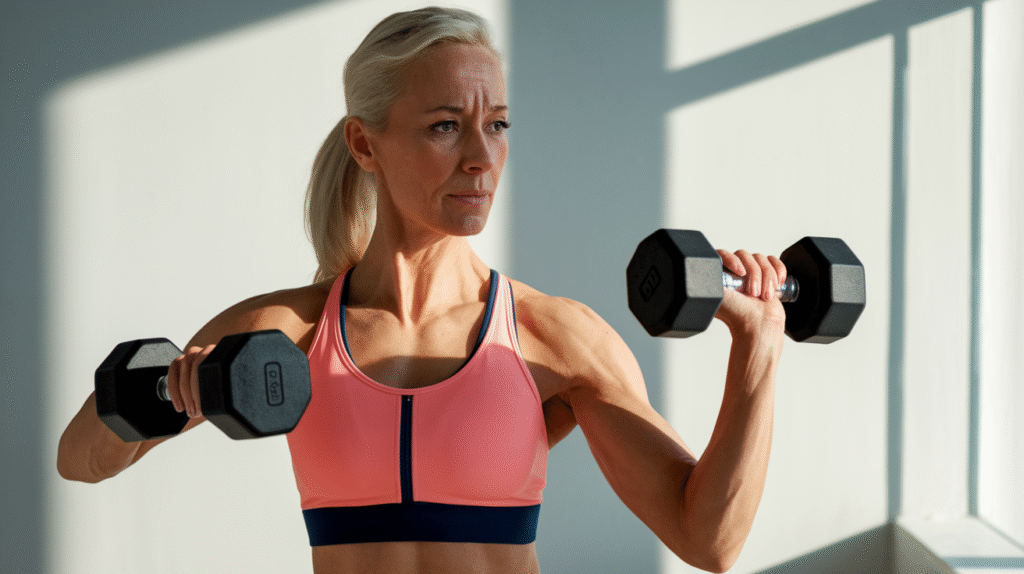
Your arms haven’t betrayed you—they’re simply responding to significant hormonal and physiological changes happening in your body. After 40, estrogen levels begin their gradual decline, which directly affects how your body stores fat and maintains muscle.
The upper arms become a prime storage location for excess fat, while the tricep muscles underneath lose mass and definition.
Sarcopenia, the age-related loss of muscle mass, begins around age 30 but accelerates significantly after 40. You can lose up to 3-5% of your muscle mass per decade if you don’t actively work to maintain it. The triceps, being one of the larger muscle groups in your arms, are particularly vulnerable to this loss.
But here’s where it gets interesting: targeted tricep work is MORE effective than random arm exercises precisely because of these changes. Your body becomes more responsive to focused, intentional strength training.
When you work your triceps with proper resistance and form, you’re not just building muscle—you’re boosting your metabolism, improving insulin sensitivity, and creating lean tissue that burns calories even while you sleep.
Why Traditional “Toning” Advice Fails Women Over 40
You’ve probably heard it a thousand times: “Use light weights and do lots of reps to tone without bulking up.” This advice is not only outdated—it’s actively working against your goals.
The myth of “toning” has wasted countless hours for women everywhere. Here’s what actually happens: muscles either grow or shrink. There’s no separate “toning” mechanism. Those light weights with endless repetitions simply don’t provide enough stimulus to build the muscle that creates the defined, sculpted look you’re after.
You need progressive resistance to see real results. This means gradually increasing the challenge to your muscles over time—whether through heavier weights, more reps, slower tempo, or shorter rest periods. Your muscles must be challenged beyond their current capacity to adapt and grow stronger.
After 40, proper form becomes even more critical for joint health. Your connective tissues, tendons, and ligaments don’t recover as quickly as they once did. This doesn’t mean you should avoid challenging yourself—it means you need to be smarter about how you train. Perfect form with moderate weight beats heavy weight with poor form every single time.
And let’s address the elephant in the room: spot reduction doesn’t work. You can’t exercise fat away from specific body parts. What does work is building muscle in your triceps while reducing overall body fat through a combination of strength training, smart nutrition, and consistency. The muscle you build creates shape and definition, while fat loss reveals that hard work.
The 15-Minute Advantage for Busy Women
Shorter, focused workouts often produce better results than hour-long sessions. Research shows that muscle fatigue occurs within 30-45 minutes of intense training, and continuing beyond that point offers diminishing returns while increasing injury risk.
Fifteen minutes of focused tricep work is the sweet spot. It’s long enough to thoroughly fatigue the muscle group, triggering the adaptation response you need for growth, but short enough to maintain perfect form throughout and recover adequately between sessions.
The science backs this up: optimal training duration for a single muscle group is 15-20 minutes. Beyond that, you’re either not working hard enough or you’re including unnecessary exercises that dilute your results.
But here’s the real magic: consistency beats intensity every single time. A 15-minute workout you’ll actually do three times per week delivers exponentially better results than an hour-long routine you dread and skip. This workout fits into your real life—before work, during lunch, after dinner, or while watching your favorite show. No special clothing, no commute, no excuses.
Your Complete 15-Minute Tricep Workout (No Gym Needed)

Exercise 1: Dumbbell Overhead Tricep Extensions (3 minutes)
This exercise is your foundation for building tricep strength and size. Start by selecting a single dumbbell—beginners should start with 5-8 pounds, while intermediate exercisers can use 10-15 pounds.
Stand with feet shoulder-width apart, core engaged. Hold one dumbbell with both hands, wrapping your palms around one end. Raise the dumbbell overhead, arms fully extended but elbows not locked. This is your starting position.
The movement: Slowly lower the dumbbell behind your head by bending only at the elbows. Keep your upper arms stationary and close to your head—they shouldn’t move at all. Lower until you feel a deep stretch in your triceps, typically when your forearms are parallel to the floor. Pause for one second, then press the weight back up by straightening your arms.
Common mistakes women over 40 make include flaring the elbows outward (keep them pointed forward), arching the lower back (engage your core), and using momentum instead of controlled movement. If you feel strain in your shoulders, you’re either using too much weight or allowing your upper arms to drift forward.
Modification for shoulder sensitivity: Perform the exercise seated with back support, which prevents compensation through the lower back and reduces shoulder strain.
Complete 3 sets of 12-15 reps with 45-60 seconds rest between sets.
Exercise 2: Tricep Dips Using a Chair or Bench (3 minutes)
Tricep dips are incredibly effective because they use your body weight as resistance, and you can easily modify the difficulty level.
Find a sturdy chair or bench. Sit on the edge and place your hands next to your hips, fingers pointing forward, gripping the edge. Walk your feet forward until your hips are off the chair, knees bent at 90 degrees (beginner) or legs extended straight (advanced). This is your starting position.
The movement: Lower your body by bending your elbows to 90 degrees, keeping them pointing straight back—not flaring out to the sides. Your hips should drop straight down, staying close to the chair. You should feel intense engagement in the backs of your arms. Press through your palms to straighten your arms and return to the starting position.
Protect your wrists by keeping them strong and straight—if they bend backward, you’re placing too much stress on the joint. Protect your shoulders by not lowering past 90 degrees at the elbow and keeping your shoulders down and back, not hunched up toward your ears.
The burn you should feel: intense fatigue in the back of your upper arms. Pain that signals you should stop: sharp pain in shoulders, elbows, or wrists, or any pinching sensation in the shoulder joint.
Complete 3 sets of 10-12 reps with 45-60 seconds rest between sets.
Exercise 3: Tricep Kickbacks with Dumbbells (3 minutes)
Kickbacks are perfect for sculpting definition because they isolate the tricep muscle with minimal involvement from other muscle groups.
Hold a light dumbbell in each hand (3-8 pounds is typically appropriate). Hinge forward at the hips, keeping your back flat and core tight. Bend your knees slightly. Bring your upper arms alongside your torso, elbows bent at 90 degrees. This is your starting position.
The movement: Keeping your upper arms completely still, extend your forearms backward by straightening your elbows. Squeeze your triceps hard at the top of the movement, holding for one second. Slowly return to the starting position with control.
The key to this exercise is maintaining constant tension on the tricep. Many women swing the weight up using momentum—this is wasted effort. The movement should be slow and controlled, taking 2 seconds to extend, 1 second to squeeze, and 2 seconds to return.
Use a mirror or record yourself to check that your upper arms stay glued to your sides throughout the movement. Any movement in the upper arm means you’re using your shoulders instead of isolating your triceps.
Breathing technique matters: exhale as you extend the arm backward (the hard part), inhale as you return to the starting position.
Complete 3 sets of 12-15 reps per arm with 45-60 seconds rest between sets.
Exercise 4: Close-Grip Push-Ups (3 minutes)
Push-ups are the ultimate functional exercise, and the close-grip variation shifts emphasis from chest to triceps.
Hand positioning is everything: Place your hands directly under your shoulders (not wide), with fingers pointing forward and index fingers nearly touching. Your body should form a straight line from head to heels.
Modifications for every fitness level: – Wall push-ups: Perform against a wall, standing 2-3 feet away – Incline push-ups: Use a sturdy table, countertop, or bench – Knee push-ups: Drop to your knees but maintain a straight line from knees to head – Full push-ups: Traditional position on toes
The movement: Lower your body by bending your elbows, keeping them close to your sides (not flaring out). Lower until your chest nearly touches the floor or until your elbows reach 90 degrees. Press back up to the starting position.
Maintain proper alignment by engaging your core throughout—don’t let your hips sag or pike upward. Your body should move as one solid unit.
Build strength progressively over weeks. Start with the easiest modification that allows you to complete 8 reps with good form. When you can complete 12 reps easily, progress to the next level.
Complete 3 sets of 8-12 reps with 45-60 seconds rest between sets.
Workout Structure and Rest Periods
Warm-up (2 minutes): Arm circles forward and backward (20 each direction), shoulder rolls, and 10 bodyweight tricep dips to prepare your joints and increase blood flow.
Rest periods matter more after 40. Your muscles need 45-60 seconds to partially recover between sets. This isn’t weakness—it’s smart training that allows you to maintain proper form and intensity throughout the workout.
Circuit vs. traditional sets: Traditional sets (completing all sets of one exercise before moving to the next) are more effective for building tricep strength and size. Circuits (rotating through all exercises) burn more calories but sacrifice some muscle-building potential.
Cool-down stretches (2 minutes): – Overhead tricep stretch: Reach one arm overhead, bend the elbow, use the opposite hand to gently pull the elbow – Cross-body shoulder stretch: Pull one arm across your chest – Doorway chest stretch: Opens up the front of your shoulders
These stretches reduce soreness and improve flexibility, making your next workout more comfortable.
Maximizing Your Results: Beyond the 15 Minutes

Nutrition Strategies That Support Arm Toning
Your tricep transformation happens in the kitchen as much as during your workout. Women over 40 need more protein than younger women—aim for 0.8-1.0 grams per pound of body weight daily. This increased requirement supports muscle maintenance and growth as hormones decline.
Protein timing matters too. Consuming 20-30 grams of protein within two hours after your workout provides the building blocks your muscles need for repair and growth. Greek yogurt, protein shakes, eggs, or lean chicken all work perfectly.
Hydration plays a surprising role in muscle definition and skin appearance. Dehydrated muscles look flat and undefined, while well-hydrated muscles appear fuller and more sculpted. Drink at least 8-10 glasses of water daily, more on workout days.
Crash dieting sabotages your arm transformation by forcing your body to break down muscle for energy. You need adequate calories to build muscle—typically 200-300 calories below maintenance for fat loss while preserving muscle, not the dramatic deficits many diets recommend.
Simple meal timing tips: eat a balanced meal with protein and carbs 2-3 hours before your workout for energy, and prioritize protein after training for recovery. Don’t train on an empty stomach—you won’t have the energy to push hard enough for results.
Recovery and Frequency: How Often to Train Triceps
Training triceps 2-3 times per week is the sweet spot for women over 40. This frequency provides enough stimulus for growth while allowing adequate recovery time. Your muscles don’t grow during the workout—they grow during rest.
Rest days are when the magic happens. After you stress your muscles with resistance training, they need 48-72 hours to repair and rebuild stronger. Training the same muscle group daily prevents this recovery and leads to overtraining, not faster results.
Active recovery options complement tricep training without interfering with muscle growth. Walking, gentle yoga, swimming, or cycling at low intensity increases blood flow to muscles, speeding recovery without adding stress.
Signs you’re overtraining: persistent muscle soreness lasting more than 3 days, decreased performance in workouts, trouble sleeping, increased irritability, or elevated resting heart rate. If you notice these signs, take an extra rest day and reduce training frequency.
Tracking Progress the Right Way
The scale doesn’t tell the tricep story. Muscle is denser than fat, so as you build tricep muscle and lose arm fat, the scale might not move much—or might even increase slightly. This is progress, not failure.
Take progress photos and measurements that matter: Measure around the fullest part of your upper arm every two weeks. Take photos from the same angle, in the same lighting, wearing the same clothing. Front, side, and back views all reveal different aspects of your transformation.
Celebrate strength gains by tracking weight increases and rep improvements in a simple notebook or phone app. If you started overhead extensions with 8 pounds and now use 12 pounds, that’s measurable progress that predicts visible results.
Realistic timeline: Expect to feel stronger within 2 weeks, notice improved muscle tone within 4 weeks, and see visible definition within 6-8 weeks of consistent training. Everyone progresses at different rates based on starting point, nutrition, genetics, and consistency. Patience pays off—trust the process.
Troubleshooting Common Challenges for Women Over 40
“I Don’t Feel It in My Triceps”
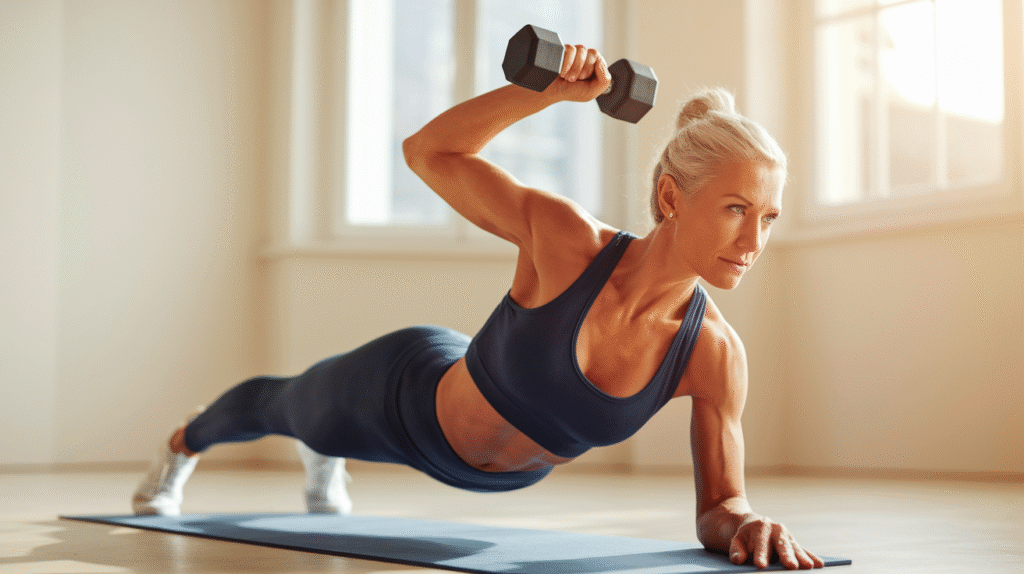
The mind-muscle connection is real and developable. Before each set, place your opposite hand on your tricep and flex it. Feel the muscle contract. During the exercise, visualize that same contraction happening with each rep.
Form adjustments that shift tension to the right place: Slow down your repetitions dramatically. Take 3 seconds to lower, pause for 1 second, then 2 seconds to lift. This eliminates momentum and forces your triceps to do all the work.
Lighter weight with perfect form beats heavy weight with poor form every time. If you can’t feel your triceps working, reduce the weight by 30-50% and focus entirely on the muscle contraction. Once you master the feeling, gradually increase weight while maintaining that connection.
Using tempo changes increases tricep activation. Try a 4-2-1 tempo: 4 seconds lowering, 2-second pause at the bottom, 1-second press up. This extended time under tension maximizes muscle engagement.
Dealing with Joint Pain or Previous Injuries
Shoulder-friendly modifications exist for every exercise. For overhead extensions, reduce the range of motion—don’t lower the weight as far behind your head. For dips, limit depth to where you feel comfortable. For kickbacks, reduce weight and focus on the squeeze at the top.
When to push through discomfort vs. when to stop: Muscle burn and fatigue are normal and expected—push through these. Sharp pain, pinching sensations, or pain that worsens with each rep means stop immediately.
Working around elbow sensitivity: Avoid locking out your elbows at the top of movements. Keep a slight bend to maintain constant tension on the muscle while protecting the joint. Use an elbow sleeve for compression and support if needed.
The importance of consulting healthcare providers: If you have persistent pain, previous injuries, or any concerns, get professional clearance before starting this program. A physical therapist can provide personalized modifications that keep you safe while making progress.
Breaking Through Plateaus
Progressive overload strategies don’t always require heavier weights. Increase reps (if you’re doing 12, work toward 15), decrease rest periods (45 seconds instead of 60), or add an extra set.
Adding resistance bands creates variable tension that challenges your muscles differently than dumbbells alone. Loop a resistance band around dumbbells during overhead extensions or kickbacks for increased resistance at the top of the movement where your triceps are strongest.
Changing grip positions and angles provides new stimulus. For overhead extensions, try holding the dumbbell vertically instead of horizontally. For dips, adjust foot position. Small changes create new adaptation demands.
The role of overall body composition: Sometimes your triceps are developing perfectly, but excess body fat obscures the definition. Addressing nutrition and overall fat loss through a slight caloric deficit reveals the muscle you’re building. You can’t out-exercise poor nutrition.
Conclusion
Fifteen minutes is enough to build strong, sculpted triceps—no excuses needed. This workout respects your time, your joints, and your busy life while delivering the results you’re after. You don’t need expensive equipment, a gym membership, or hours of your day. You need consistency, proper form, and the commitment to show up for yourself three times per week.
The empowering feeling of strength that comes with consistent training extends far beyond your arms. You’ll notice yourself lifting grocery bags more easily, playing with grandchildren without fatigue, and reaching overhead without hesitation. Physical strength builds mental confidence that radiates into every area of your life.
Every woman over 40 can transform her arms with the right approach. Your age isn’t a limitation—it’s simply a factor that requires smarter training. The exercises in this workout are proven, effective, and specifically chosen for your changing body. They work if you work them.
Start with just one workout this week and build from there. You don’t need to be perfect—you need to be consistent. Mark three days on your calendar right now. Commit to those 15 minutes. Show up even when you don’t feel like it, especially when you don’t feel like it.
Your arms are capable of amazing things at any age. The strength you build over the next 8 weeks will surprise you. The definition you see emerging will motivate you. The confidence you gain will transform you.
Stop waiting for the perfect time, the perfect plan, or the perfect motivation. You have everything you need right now. Grab your dumbbells, set a timer for 15 minutes, and prove to yourself what’s possible. Your stronger, more sculpted arms are waiting—go claim them.