10 Minute Pilates for Bone Density For Women 40+
Your bones are talking to you—are you listening?
If you’re a woman over 40, bone health isn’t just something to think about later. It’s happening right now, and the choices you make today directly impact your strength and independence tomorrow.
Here’s the truth: after age 30, we naturally start losing bone density. By menopause, that loss accelerates. But you’re not powerless here.
Weight-bearing exercise is one of the most proven ways to maintain and even build bone strength. When you put controlled stress on your bones through movement, they respond by becoming denser and stronger.
Think of it like this—your bones are living tissue that adapts to the demands you place on them. Use them, and they strengthen. Ignore them, and they weaken.
This is where Pilates becomes your ultimate ally.
Unlike high-impact exercises that might feel intimidating or risky, Pilates offers gentle, controlled movements that are perfect for building bone density safely.
You don’t need to jump, run, or lift heavy weights. Instead, you’ll use your own body weight and precise movements to create the resistance your bones need to stay strong.
In this guide, you’ll discover a complete 10-minute Pilates routine specifically designed to support bone health. This isn’t some complicated workout that requires fancy equipment or previous experience.
It’s a simple, effective sequence you can start today—right in your living room. You’ll learn exactly which movements target the bones most vulnerable to weakness (your spine, hips, and wrists), how to perform each exercise with proper form, and why these gentle movements deliver amazing results when practiced consistently.
The best part? Ten minutes is all you need. No more excuses about not having time. This routine fits into the busiest schedule and gives your bones the attention they deserve.
Why Pilates Is Perfect for Building Bone Density
Understanding the Bone-Building Benefits
Let’s talk about what actually makes bones stronger. Research shows that bones respond to mechanical stress—when you apply controlled force through weight-bearing movements, your bones literally rebuild themselves to handle that stress. This process is called bone remodeling, and it’s happening in your body right now.
Pilates creates this essential stress through controlled, deliberate movements where you’re supporting your body weight in various positions. When you hold a plank, lift your hips in a bridge, or balance on one side during leg lifts, you’re creating tension that pulls on your bones. Your body interprets this as a signal to strengthen those bones.
The science backs this up completely. Studies on resistance training consistently show improvements in bone mineral density, particularly in the spine and hips—the exact areas where fractures become most dangerous as we age. What makes Pilates special is that it provides this resistance training without the impact that can feel harsh on aging joints.
Here’s something many people misunderstand: gentle doesn’t mean ineffective. The slow, controlled nature of Pilates movements actually maximizes the bone-building benefits. When you move slowly through each exercise, maintaining proper alignment and engaging the right muscles, you create sustained tension that’s perfect for stimulating bone growth. Quick, bouncy movements might feel more intense, but they’re not necessarily better for bone health.
Why Beginners Love This Approach
Starting a new exercise routine can feel overwhelming, especially if you’re concerned about injury or haven’t been active in a while. Pilates removes those barriers beautifully.
You don’t need any equipment to begin this bone-building journey. No dumbbells, no machines, no special gear—just you and a comfortable surface. This simplicity makes it easy to start today, not next week when you’ve purchased everything on some intimidating shopping list.
The modifications available in Pilates are truly amazing. Every single exercise can be adjusted to match your current fitness level. Struggling with a full plank? Start with your knees down. Finding bridges too challenging? Reduce the height of your lift. As you build strength, you naturally progress to more challenging variations. This built-in flexibility means you’re never doing too much or too little—you’re working at exactly the right level for your body.
The low-impact nature of Pilates addresses one of the biggest concerns for people worried about bone health: the fear of falling or getting hurt. These movements happen in controlled positions, often close to the ground, where you feel stable and safe. You’re building strength without risking injury, which means you’ll actually stick with the routine instead of abandoning it after one scary moment.
The Amazing 10-Minute Advantage
Ten minutes might sound too short to make a real difference, but that’s exactly why this routine works so well.
When you commit to just 10 minutes, you remove the mental barrier that stops most people from exercising consistently. You’re not promising yourself an hour at the gym or a 30-minute workout that feels impossible to fit into your day. You’re committing to 10 minutes—shorter than most TV commercial breaks, quicker than scrolling through social media, easily squeezed in before breakfast or during your lunch break.
This time frame is perfect for building a daily habit. Research on habit formation shows that small, consistent actions create lasting change better than occasional intense efforts. Doing 10 minutes of Pilates every day delivers better results than doing an hour-long class once a week and then feeling too sore or busy to continue.
For beginners, especially those who feel intimidated by fitness culture, 10 minutes feels achievable. It’s not a major time commitment that requires rearranging your entire schedule. It’s a simple, doable practice that fits into real life. And here’s the beautiful truth: once you start seeing results—better posture, less back pain, improved balance—those 10 minutes become the best part of your day.
Essential Pilates Principles for Bone Health
The Foundation: Proper Alignment and Form
Quality trumps quantity every single time in Pilates. You could do 100 repetitions with poor form and see no results, or you could do 10 perfect repetitions and feel the difference immediately. This is especially true for bone health—proper alignment ensures you’re loading your bones correctly and safely.
Neutral spine is the foundation of almost every Pilates movement. This means your spine maintains its natural curves—not flattened against the floor, not overly arched. To find neutral spine while lying on your back, imagine your pelvis as a bowl of water. You don’t want to spill the water forward toward your belly button or backward toward your spine. This balanced position protects your back while allowing proper muscle engagement.
Core engagement doesn’t mean sucking in your stomach or holding your breath. Instead, think about gently drawing your lower abdominal muscles toward your spine, as if you’re zipping up a tight pair of jeans. This engagement should feel supportive, not restrictive. You should still be able to breathe fully and move freely.
Here’s a simple alignment tip that works for every exercise: stack your joints. Shoulders over wrists, hips over knees, ears over shoulders. When your joints are properly aligned, you create the most effective load on your bones without unnecessary strain on your muscles or ligaments.
Breathing Techniques That Make a Difference
Breathing might seem like the least important part of exercise—after all, your body breathes automatically. But in Pilates, breath is the key that unlocks everything else.
The complete Pilates breathing pattern involves inhaling deeply through your nose, expanding your ribcage to the sides and back (not just lifting your chest), then exhaling fully through your mouth, engaging your core muscles as you release the air. This pattern does two essential things: it oxygenates your muscles so they work more efficiently, and it helps you maintain core engagement throughout each movement.
Proper breathing directly enhances the bone-building benefits of your practice. When you exhale during the challenging part of an exercise (like lifting into a bridge or holding a plank), you naturally engage your deep core muscles more effectively. This creates better stability and allows you to maintain proper form longer, which means more sustained tension on your bones.
For beginners, follow this simple cue: breathe in to prepare, breathe out to move. Before you lift into a bridge, inhale. As you lift, exhale. Before you lower down, inhale. As you lower, exhale. This rhythm keeps you from holding your breath and helps coordinate your movement with your core engagement.
Progressive Resistance: Starting Gentle, Building Strong
Your body provides its own resistance through gravity and positioning. When you hold a plank, you’re resisting gravity pulling your hips toward the floor. When you lift your leg in a side-lying position, you’re working against gravity trying to pull that leg down. This natural resistance is perfect for beginners and completely effective for building bone density.
Understanding the right intensity is essential. You should feel your muscles working—that gentle burning sensation or shaking that tells you they’re being challenged—but you shouldn’t feel pain in your joints or strain in your back. If you’re grimacing, holding your breath, or losing your alignment, you’re working too hard. Scale back and focus on form.
Safe progression happens naturally when you practice consistently. After a few weeks of daily practice, you’ll notice that exercises that once felt challenging now feel manageable. That’s your signal to progress. Maybe you hold positions a few seconds longer, add an extra repetition, or try a more challenging variation. This gradual increase in difficulty keeps your bones adapting and strengthening over time.
The ultimate goal isn’t to do the hardest possible version of each exercise. It’s to do each exercise with perfect form at a level that challenges you appropriately. That’s what builds strong bones safely and effectively.
Your Complete 10-Minute Pilates Routine for Stronger Bones
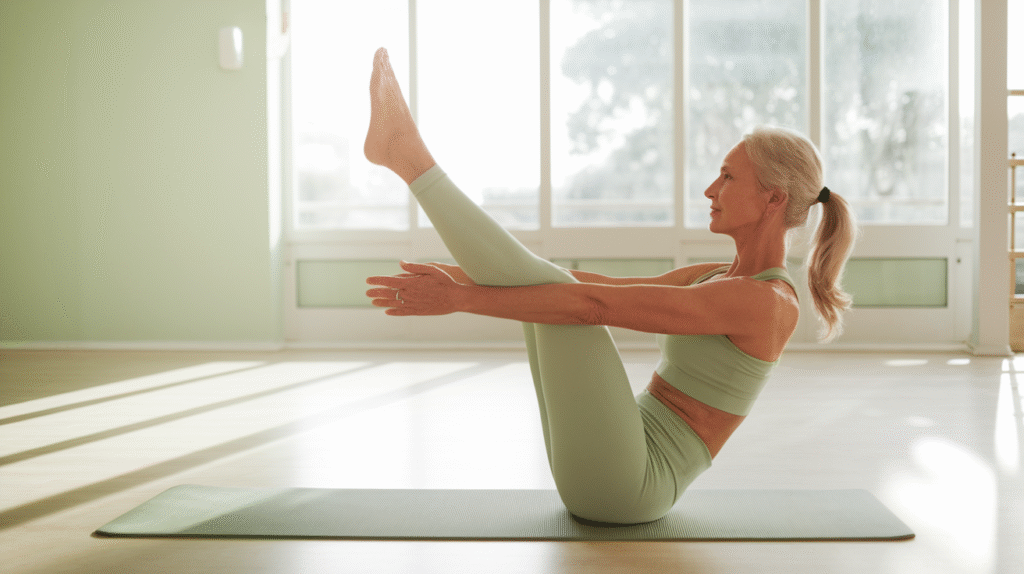
Warm-Up Movements (2 minutes)
Pelvic Tilts: Start on your back with knees bent and feet flat on the floor, hip-width apart. Place your hands on your hip bones. Gently tilt your pelvis so your lower back presses toward the floor, then tilt it the opposite way so your lower back arches slightly. Move slowly and smoothly between these positions for 30 seconds. This gentle movement warms up your spine and helps you find that neutral position you’ll use throughout the routine.
Cat-Cow Stretches: Come onto your hands and knees with shoulders over wrists and hips over knees. Inhale as you let your belly drop toward the floor, lifting your chest and tailbone (cow position). Exhale as you round your spine, tucking your tailbone and dropping your head (cat position). Flow between these positions for 60 seconds. This movement mobilizes every vertebra in your spine and prepares your back for the exercises ahead.
Shoulder Rolls: Still on hands and knees, or sitting back on your heels if that’s more comfortable, make slow circles with your shoulders. Roll them backward for 15 seconds, then forward for 15 seconds. This simple movement prepares your upper body for weight-bearing positions and helps you find proper shoulder alignment.
Core Bone-Building Exercises (6 minutes)
Modified Plank (Tabletop Hold): From hands and knees, walk your hands forward slightly so your body forms a straight line from shoulders to knees (not hips to knees). Your shoulders should be directly over your wrists. Engage your core by drawing your belly button toward your spine. Hold this position for 20-30 seconds, breathing steadily. This exercise is amazing for building bone density in your wrists, arms, and spine.
To make it easier: Keep your knees wider apart or don’t walk your hands as far forward. To make it harder: Lift one foot slightly off the floor for 10 seconds, then switch sides.
Common mistakes to avoid: Don’t let your hips sag toward the floor or pike up toward the ceiling. Don’t lock your elbows. Keep a micro-bend in your arms and maintain that straight line from shoulders to knees.
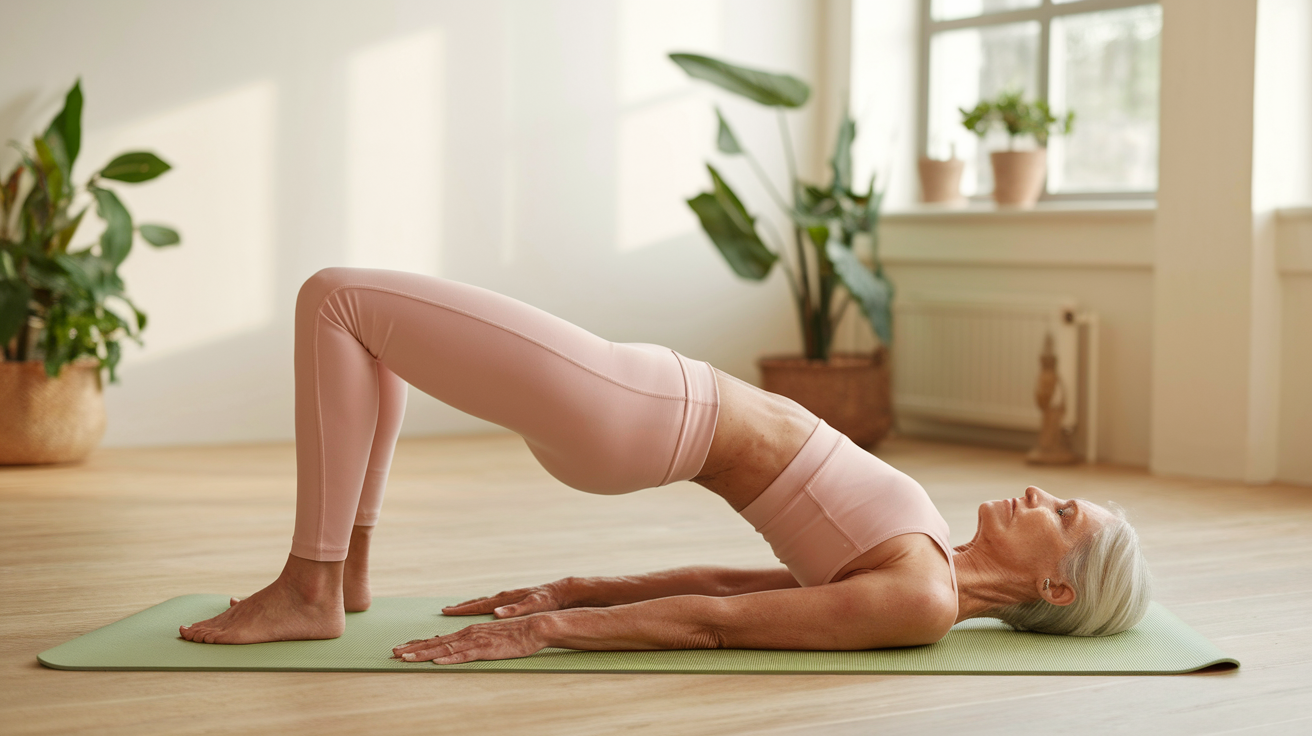
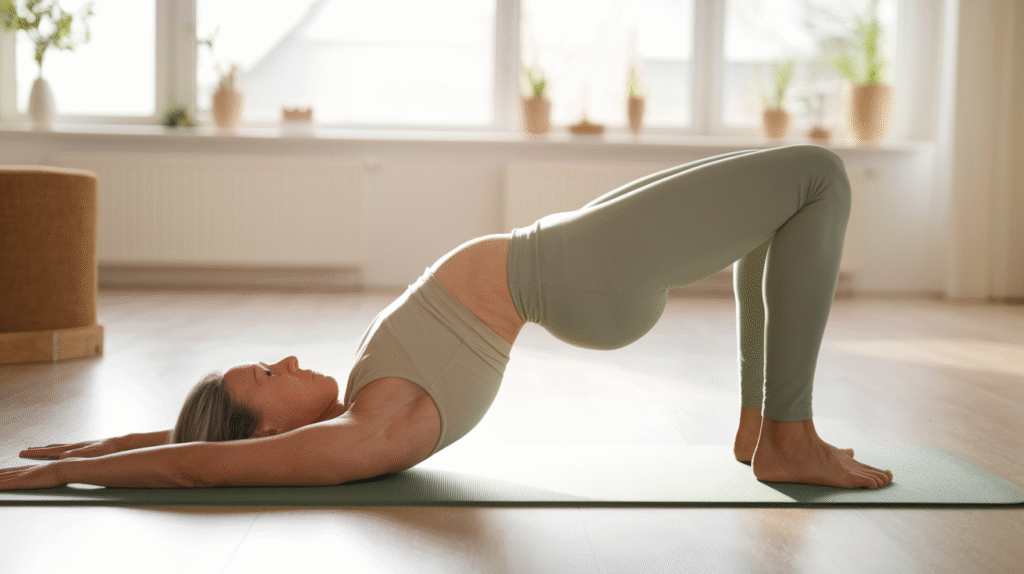
Bridge Lifts: Lie on your back with knees bent, feet flat on the floor hip-width apart, arms by your sides. Press your feet firmly into the floor as you exhale and lift your hips toward the ceiling, creating a straight line from shoulders to knees. Hold at the top for 3 seconds, then slowly lower down. Complete 10-12 repetitions. This exercise is essential for building bone density in your hips and spine—two of the most important areas for preventing fractures.
Proper form cues: Keep your knees aligned over your ankles (don’t let them splay out or collapse in). Squeeze your glutes at the top. Press your arms into the floor for stability. Your weight should be on your shoulders and feet, never on your neck.
Avoid these mistakes: Don’t arch your lower back excessively at the top. Don’t hold your breath. Don’t let your knees fall inward.
Side-Lying Leg Lifts: Lie on your right side with your body in a straight line, head resting on your extended right arm. Place your left hand on the floor in front of your chest for balance. Keeping your left leg straight and your foot flexed, exhale as you lift that leg about hip height. Inhale as you lower it with control. Complete 10 lifts, then switch to the other side. This movement is perfect for building bone density in your hips, which is crucial for preventing hip fractures later in life.
Alignment tips: Keep your hips stacked—don’t let your top hip roll forward or backward. Your leg should lift directly to the side, not forward or back. Keep your core engaged so your waist doesn’t collapse toward the floor.
Breathing pattern: Exhale as you lift, inhale as you lower. This helps maintain core engagement throughout the movement.
Pilates Swimming (Modified): Lie on your stomach with arms extended overhead and legs straight behind you. Lift your head, chest, and arms slightly off the floor (just a few inches). Hold this position while making small, controlled movements with your arms—like you’re swimming through water. Continue for 20-30 seconds. This exercise provides complete back strengthening, which is essential for building spinal bone density and preventing compression fractures.
Beginner-friendly modifications: If lifting your chest feels too challenging, keep your forehead on the floor and just work your arms. You can also bend your elbows slightly rather than keeping your arms completely straight.
Why this works: When you hold your body against gravity in this position, you’re creating resistance that strengthens the small muscles along your spine and stimulates bone growth in your vertebrae.
Cool-Down and Stretch (2 minutes)
Child’s Pose: Sit back on your heels and fold forward, extending your arms in front of you or resting them by your sides. Let your forehead rest on the floor. Hold for 45 seconds, breathing deeply. This gentle position releases any tension in your back after the strengthening exercises.
Seated Spinal Twist: Sit with legs extended in front of you. Bend your right knee and place your right foot on the outside of your left knee. Twist gently to the right, placing your left elbow on the outside of your right knee. Hold for 30 seconds, breathing steadily, then switch sides. This restores mobility to your spine and releases any tightness.
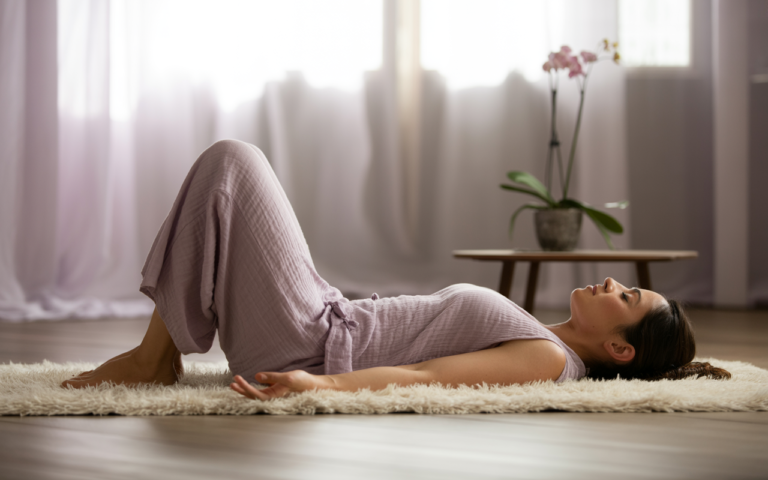
Final Relaxation: Lie on your back with legs extended and arms by your sides, palms facing up. Close your eyes and do a quick body scan. Notice how your back feels against the floor, how your breathing has deepened, how your muscles feel after working. Rest here for 45 seconds, acknowledging the amazing work you just did for your bone health.
Tips for Success and Making It a Habit
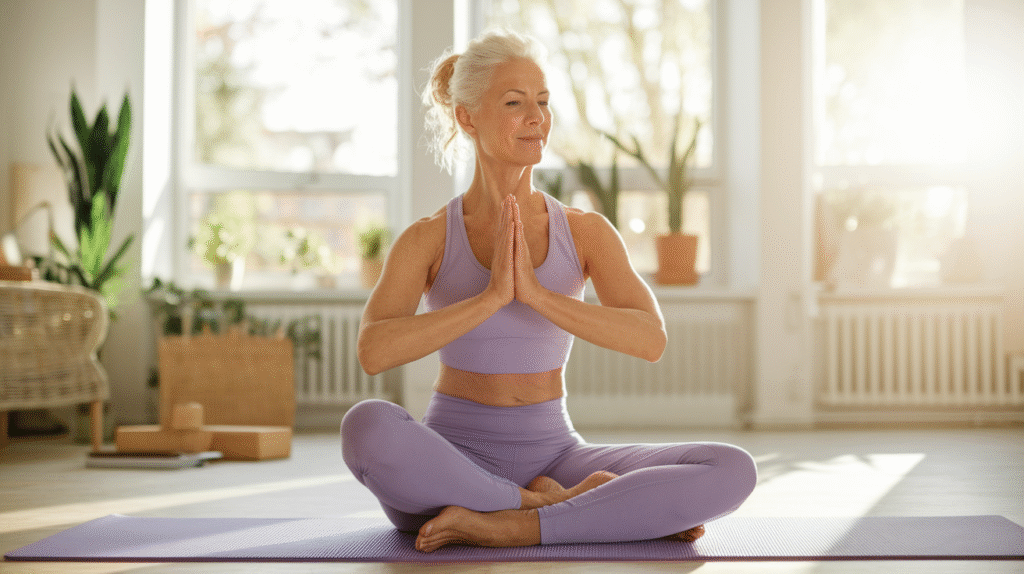
Creating Your Perfect Practice Space
You need surprisingly little to make this routine work. A yoga mat provides cushioning, but a folded towel or blanket works perfectly if you don’t have one. Choose a space where you can lie down with your arms extended overhead without hitting furniture—that’s literally the only space requirement.
The best time to practice is whatever time you’ll actually do it consistently. Many people love morning Pilates because it energizes them for the day ahead and gets the workout done before life gets busy. Others prefer evening practice as a way to release the day’s tension. Try different times and notice when you feel most motivated and focused.
Set yourself up for success with simple reminders. Put your mat out the night before. Set a phone alarm labeled “10 Minutes for Stronger Bones.” Link your practice to an existing habit—maybe right after your morning coffee or before your evening shower. These small environmental cues make consistency effortless.
Tracking Your Progress the Easy Way
You don’t need complicated apps or fitness trackers to monitor your progress. Simple observation tells you everything you need to know. After two weeks of consistent practice, notice: Do you hold plank position longer without shaking? Can you lift your hips higher in bridges? Does your balance feel steadier during leg lifts?
Consistency matters infinitely more than intensity. Doing this gentle 10-minute routine every day for a month delivers better bone-building results than doing an intense 60-minute workout once a week. Your bones respond to regular, repeated stress, not occasional extreme effort.
Celebrate the small wins that happen along the way. Maybe you notice your posture improving throughout the day. Perhaps your lower back pain decreases. You might feel steadier on your feet or more confident in your movements. These improvements are just as important as bone density measurements and they happen much faster.
Common Questions Answered
How often should beginners practice this routine? Aim for 5-7 days per week. Daily practice is ideal for building bone density because bones respond best to consistent, regular stimulation. However, if you need a rest day, take it—listening to your body is essential.
Can this routine really make a difference in bone density? Yes, absolutely. Research consistently shows that weight-bearing exercise improves bone mineral density, particularly when practiced regularly over time. While this routine alone won’t reverse severe osteoporosis, it’s a proven, effective tool for maintaining and improving bone health, especially when combined with proper nutrition.
What if certain movements feel uncomfortable? Discomfort in your muscles (that burning, working sensation) is normal and good. Pain in your joints, sharp sensations, or pinching feelings are signals to stop and modify. Never push through actual pain. Try the easier variation, reduce your range of motion, or skip that exercise and focus on the others.
When should you expect results? You’ll feel immediate benefits—better posture, increased body awareness, improved mood. Measurable changes in bone density take longer, typically 6-12 months of consistent practice. But the other benefits you experience along the way—strength, balance, confidence—are just as valuable.
Taking It to the Next Level
Once this routine feels comfortable (usually after 4-6 weeks), you’re ready to progress. Easy ways to increase the challenge include holding positions longer, adding more repetitions, or trying more advanced variations of each exercise.
Adding light weights (1-3 pounds) to certain movements enhances the bone-building benefits. You can hold small dumbbells during bridges or wear light ankle weights during leg lifts. The extra resistance creates more pull on your bones, stimulating greater density improvements.
Combine this Pilates routine with other proven bone-healthy activities for ultimate results. Walking, dancing, or light strength training on alternate days provides different types of bone stimulation. Variety keeps your bones adapting and prevents boredom in your fitness routine.
Now Start Working Out!
Building stronger bones doesn’t require hours at the gym, expensive equipment, or complicated routines. It requires 10 minutes of intentional, focused movement—and you now have everything you need to make that happen.
This gentle Pilates routine offers a proven, effective approach to bone health that works with your body, not against it. The controlled movements stimulate bone growth safely. The simple format fits into any schedule. The beginner-friendly modifications meet you exactly where you are right now.
Consistency with this routine brings amazing results over time. Your bones will gradually become denser and stronger. Your posture will improve. Your balance will increase. Your confidence in your body’s capabilities will grow. All from 10 minutes a day of mindful movement.
You don’t need fancy equipment, previous experience, or perfect form to begin. You just need to start. Today. Right now, if possible. Roll out that mat (or towel), set a timer for 10 minutes, and move through this sequence. Your future self—standing tall, moving confidently, living independently—will thank you for taking this step.
Save this guide where you can find it easily. Come back to it tomorrow and the next day. Make these 10 minutes non-negotiable in your schedule. Because taking control of your bone health at any age is one of the most empowering choices you can make.
Your bones are talking to you. It’s time to give them the answer they need: consistent, gentle, effective movement that keeps them strong for all the years ahead.