10 minute beginner workout for women over 40
Let’s talk about the elephant in the room: Life after 40 doesn’t slow down—it speeds up. You’re juggling career demands, family responsibilities, maybe aging parents, and suddenly your own health slides to the bottom of the priority list. Sound familiar?
Here’s what I know after working with hundreds of women in your exact situation: You’re not too old to start. You’re not too busy to commit. And you definitely don’t need to spend hours at the gym feeling intimidated by twenty-somethings doing complicated moves.
The fear is real—I get it. You worry about injury. You feel self-conscious. You wonder if your body can even handle exercise anymore. But here’s the truth: Your body is designed to move, and it’s craving the strength and energy that comes from consistent, intelligent movement.
This 10-minute beginner workout is different from everything else you’ve tried. It’s built specifically for women’s bodies over 40, respecting the hormonal shifts, joint considerations, and time constraints you’re facing right now. No equipment needed. No gym membership required. No judgment—just proven exercises that deliver real results.
I’m not promising overnight miracles. What I’m offering is something better: A sustainable approach that fits into your busiest day and builds genuine strength, energy, and confidence over time. Ten minutes. That’s all you need to start transforming your health today.
Why 10-Minute Workouts Are Perfect for Women Over 40
The Science Behind Short, Effective Workouts
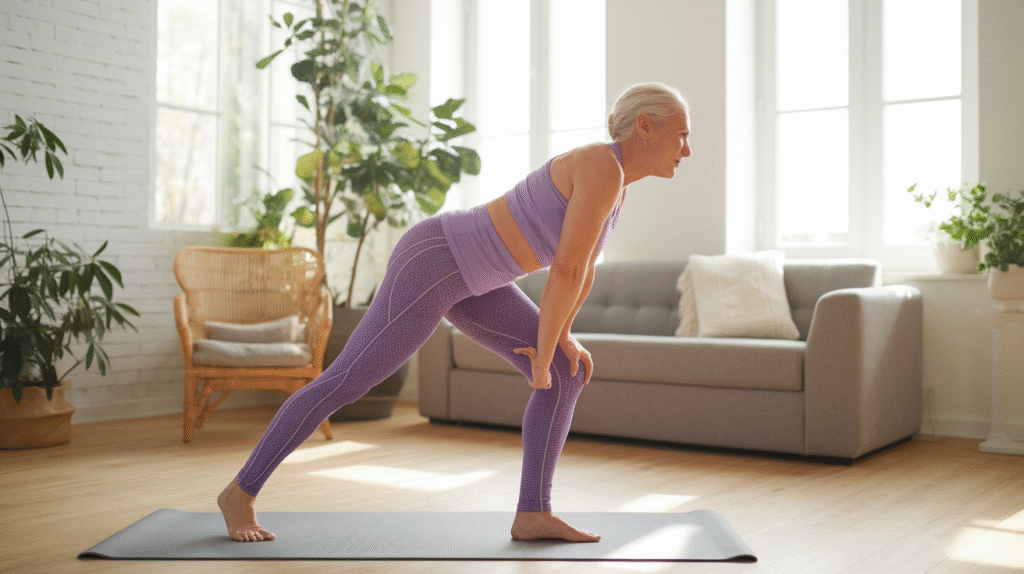
You’ve been told you need hour-long gym sessions to see results. That’s outdated advice that doesn’t serve your body or your schedule.
Research consistently shows that brief, focused exercise sessions boost metabolism more effectively than sporadic long workouts. When you exercise for 10 minutes daily, you’re creating consistent metabolic spikes that keep your body burning calories throughout the day. Compare that to working out for an hour once or twice a week—your metabolism gets one spike and then crashes back to baseline.
Here’s what makes this approach powerful for women over 40: Your hormones are shifting. During perimenopause and menopause, estrogen levels fluctuate and eventually decline, affecting how your body builds muscle and burns fat. Short, frequent workouts align perfectly with these changes, providing regular stimulus without overwhelming your recovery capacity.
The compound effect is real. One 10-minute workout might seem insignificant, but multiply that by 365 days a year. You’re looking at 60+ hours of purposeful movement—all accumulated in bite-sized chunks that never disrupted your life.
Overcoming the Biggest Obstacles
Let’s address what’s actually stopping you from exercising consistently.
The gym intimidation factor: Gone. You’re working out in your own space, wearing whatever you want, moving at your own pace. No eyes on you except your own.
The cost barrier: Eliminated. Zero equipment required means zero investment beyond your commitment. You can add dumbbells or resistance bands later if you want, but they’re not necessary to see results.
The schedule problem: Solved. Ten minutes fits before your morning shower, during your lunch break, or while dinner is cooking. You’re not rearranging your entire day—you’re claiming 10 minutes that already exist.
The confidence gap: Bridged. Starting with beginner-friendly movements in your own home builds the foundation you need. You’ll develop strength and familiarity before ever considering a gym membership.
What Your Body Needs Now (Not What It Needed at 25)
Your body at 45 has different priorities than your body at 25, and that’s not a limitation—it’s just reality.
Bone density becomes critical. After 40, women lose bone mass faster, increasing osteoporosis risk. Weight-bearing exercises like squats and lunges stimulate bone growth, keeping your skeleton strong for decades to come.
Joint health matters more. High-impact jumping and running can strain joints that need more care now. Low-impact movements that still challenge your muscles deliver results without unnecessary wear and tear.
Muscle preservation is non-negotiable. You naturally lose muscle mass after 40—about 3-5% per decade. This muscle loss directly impacts your metabolism, making weight management harder. Strength training, even bodyweight exercises, signals your body to maintain and build muscle tissue.
Functional strength trumps aesthetics. Sure, you want to look good, but what really matters is carrying groceries, playing with grandkids, and maintaining independence as you age. These exercises build real-world strength for daily activities.
The Complete 10-Minute Beginner Workout Routine
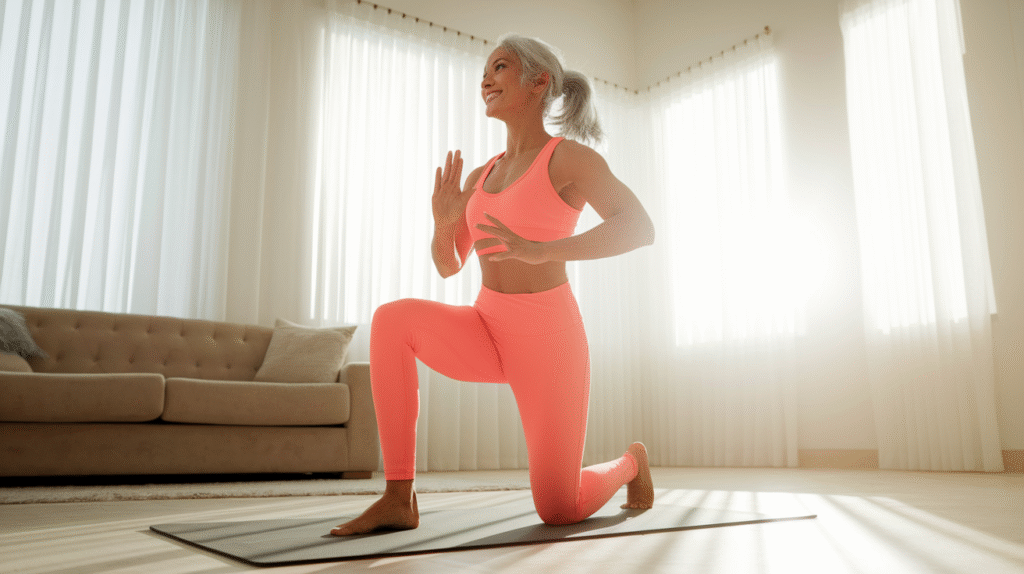
Warm-Up (2 Minutes): Prepare Your Body Safely
Never skip this. Your muscles need preparation, and your joints require lubrication before exercise. Two minutes of warming up prevents injury and improves workout effectiveness.
Arm Circles and Shoulder Rolls (30 seconds)
Stand with feet hip-width apart. Extend your arms out to the sides at shoulder height. Make small circles forward for 15 seconds, then reverse direction. Follow with shoulder rolls—lift your shoulders toward your ears, roll them back and down. This increases blood flow to your upper body and prevents shoulder strain during push-ups.
Marching in Place with High Knees (45 seconds)
March in place, lifting your knees as high as comfortable. Swing your arms naturally. This gentle cardio elevates your heart rate gradually while warming up hip flexors and leg muscles. You should feel your body temperature rising slightly.
Torso Twists (45 seconds)
Stand with feet shoulder-width apart, hands on hips or crossed over chest. Gently twist your torso left and right, keeping your hips facing forward. This activates core muscles and improves spinal mobility—essential for the exercises ahead.
Main Circuit (7 Minutes): Build Strength and Burn Fat
You’ll complete each exercise for 40 seconds, followed by 20 seconds of rest. Do the entire circuit twice. This structure keeps your heart rate elevated while allowing brief recovery between movements.
Modified Squats (40 seconds, rest 20 seconds)
Stand with feet shoulder-width apart, toes slightly pointed out. Lower your body as if sitting back into a chair, keeping your chest up and weight in your heels. Push through your heels to stand back up.
This exercise targets your glutes, quads, hamstrings, and core—the largest muscle groups in your body. That means maximum calorie burn and functional strength for everyday activities like getting out of chairs or climbing stairs.
Modification: Hold onto a sturdy chair back for balance. Reduce your range of motion if needed—even a quarter squat builds strength when you’re starting out.
Wall Push-Ups (40 seconds, rest 20 seconds)
Stand arm’s length from a wall. Place your palms flat against the wall at shoulder height. Bend your elbows to bring your chest toward the wall, then push back to starting position.
Wall push-ups tone your arms, chest, and shoulders without the joint stress of floor push-ups. You’re still building upper body strength—just with a safer angle that respects your current fitness level.
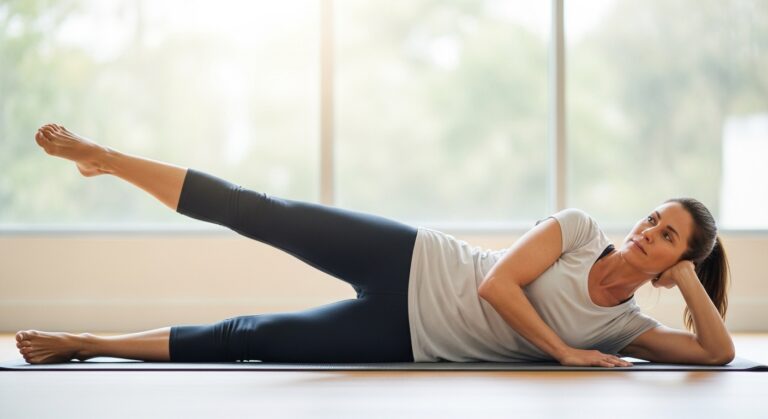
Standing Side Leg Lifts (40 seconds, rest 20 seconds)
Stand tall, holding a chair for balance if needed. Lift your right leg out to the side, keeping your toe pointed forward and your body upright. Lower with control. Do 40 seconds on one side during the first round, then switch to the left leg during the second round.
This movement sculpts your outer thighs and hips while improving balance and stability. The muscles you’re strengthening here—your hip abductors—are crucial for preventing falls as you age.
Rest 20 seconds, then repeat the entire circuit
The second round challenges your muscles more effectively than the first. Your heart rate stays elevated, maximizing fat burn. Track how many repetitions you complete each workout—watching these numbers increase proves your growing strength.
Cool-Down (1 Minute): Protect Your Muscles
These final stretches prevent soreness and improve flexibility. Your muscles are warm now, making this the perfect time to stretch.
Standing Forward Fold (20 seconds)
Stand with feet hip-width apart. Hinge at your hips and fold forward, letting your arms hang toward the floor. Bend your knees as much as needed. This stretches your hamstrings and lower back.
Quad Stretch (20 seconds each leg)
Stand on your left leg (hold a wall for balance). Bend your right knee and bring your heel toward your glutes, holding your ankle with your right hand. Feel the stretch in the front of your thigh. Switch sides.
Deep Breathing (20 seconds)
Stand tall, hands on your belly. Breathe in deeply through your nose for four counts, feeling your belly expand. Exhale slowly through your mouth for six counts. This activates your parasympathetic nervous system, signaling your body to begin recovery.
Proven Modifications and Progressions
Making It Easier When You’re Just Starting
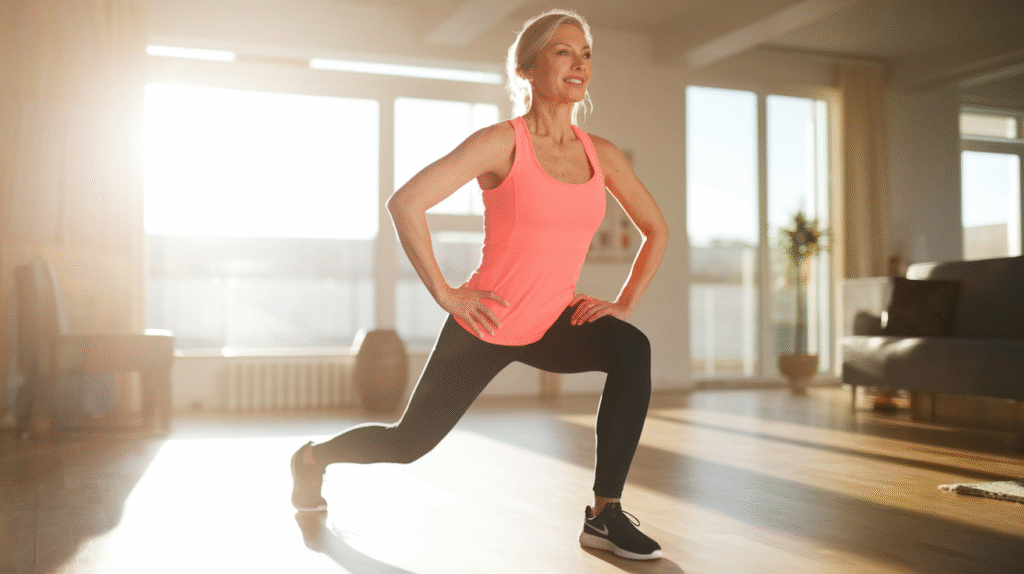
You don’t need to be perfect from day one. These modifications ensure everyone can begin right where they are.
If balance is challenging:
Keep a sturdy chair nearby for every standing exercise. There’s zero shame in using support—you’re building stability with each workout. As your balance improves over weeks, you’ll naturally rely on the chair less.
Reduce your range of motion until strength improves. A shallow squat is better than no squat. A small leg lift is better than skipping the exercise. You’re creating neural pathways and building muscle, regardless of how big your movements are.
Focus on form over speed or repetitions. Slow, controlled movements with proper form deliver better results than fast, sloppy reps. Quality always beats quantity.
If you have joint concerns:
Eliminate any movement that causes pain (different from the discomfort of challenging your muscles). Pain is your body’s warning signal—listen to it.
Choose supported variations consistently. Wall push-ups instead of floor push-ups. Squats with a chair for balance. These aren’t “cheating”—they’re intelligent exercise selection.
Consider adding a yoga mat or exercise mat for cushioning during floor stretches. The small investment protects your knees and back.
If you’re completely new to exercise:
Start with 5 minutes instead of 10. Do just one round of the circuit plus warm-up and cool-down. Build to two rounds when you’re ready—maybe after two weeks, maybe after four. Your timeline is your own.
Take longer rest periods between exercises. Need 30 seconds instead of 20? Take it. As your cardiovascular fitness improves, you’ll naturally need less recovery time.
Celebrate every single workout as a victory. You showed up. You moved your body. That’s success, period.
Making It Harder as You Get Stronger
Progress is inevitable when you’re consistent. These progressions ensure you keep challenging your body.
Add resistance:
Hold light dumbbells during squats and leg lifts. Start with 2-3 pounds—you’ll be surprised how much harder this makes the exercises. Gradually increase weight as you get stronger.
Use resistance bands around your thighs during leg lifts for added challenge. The constant tension intensifies the muscle work.
Increase time under tension by slowing down your movements. Take three seconds to lower into your squat, pause for one second at the bottom, then take two seconds to stand up.
Increase intensity:
Reduce rest periods from 20 seconds to 10 seconds between exercises. This keeps your heart rate higher and increases cardiovascular benefits.
Add five more seconds to each exercise (45 seconds work, 15 seconds rest). Those extra five seconds significantly increase the challenge.
Complete a third round when you’re ready. This transforms your 10-minute workout into a 12-minute session with even more strength-building stimulus.
Combine with other 10-minute sessions:
Do this workout in the morning and add a 10-minute walk in the evening. You’re now exercising 20 minutes daily without any single session feeling overwhelming.
Create different 10-minute routines focusing on different areas—upper body one day, lower body the next, core work the third day.
Build up to 20-30 minutes as your fitness improves by doing multiple 10-minute blocks back-to-back.
Maximizing Results: What to Do Beyond the Workout
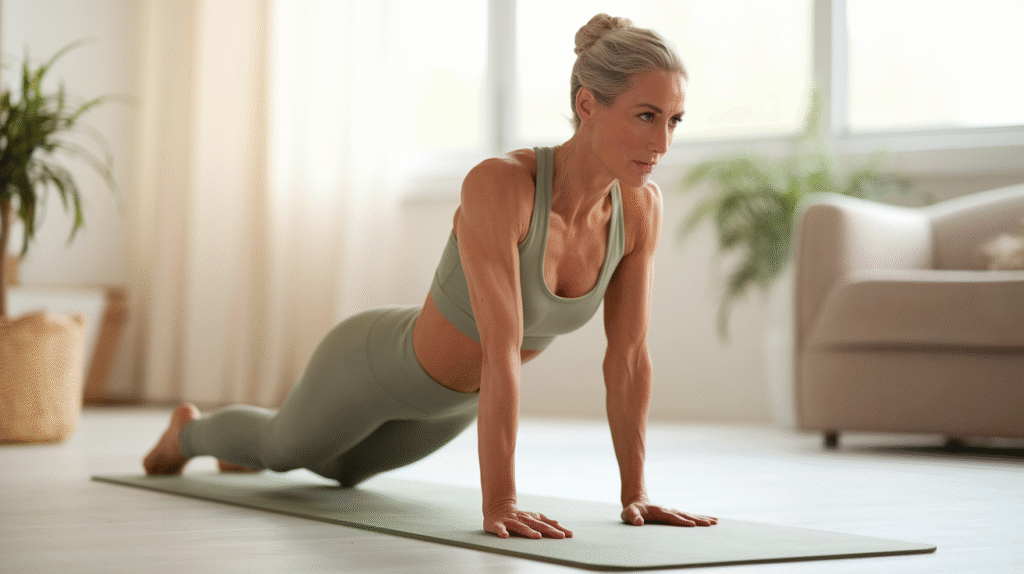
Exercise is only part of the transformation equation. What you do during the other 23 hours and 50 minutes of your day matters just as much.
Nutrition Essentials for Women Over 40
Protein priorities:
Your body needs more protein after 40 to maintain muscle mass, not less. Aim for 20-30 grams of protein per meal. This isn’t about complicated meal plans—it’s about simple swaps.
Breakfast: Two eggs with whole grain toast instead of just cereal. Greek yogurt with berries instead of regular yogurt. Protein smoothie instead of juice.
Lunch and dinner: Palm-sized portion of chicken, fish, lean beef, or legumes with every meal.
Your muscles literally cannot repair and grow stronger without adequate protein. This is non-negotiable for results.
Hydration matters more now:
Water supports joint health, aids recovery, and helps manage the metabolism changes you’re experiencing. Dehydration makes you feel tired, hungry, and sore—all things that derail consistency.
Target half your body weight in ounces daily. If you weigh 150 pounds, drink 75 ounces of water. Keep a water bottle visible throughout the day as a reminder.
Don’t fear carbs—choose wisely:
Whole grains, fruits, and vegetables provide the energy your workouts require. Your body needs carbohydrates to fuel exercise and recover afterward.
Focus on timing: Eat carbs around your workout windows. Oatmeal before your morning workout. Sweet potato with dinner after your evening session.
Vegetables are unlimited—they provide essential nutrients that support hormone balance during perimenopause and menopause.
Recovery and Rest Days
Here’s something nobody tells you: Rest days are when your body actually gets stronger. Exercise creates tiny tears in muscle fibers. Rest allows those fibers to repair and rebuild stronger than before.
Schedule at least one complete rest day weekly. On rest days, engage in active recovery: gentle walking, easy stretching, or restorative yoga. Movement without intensity aids recovery better than complete inactivity.
Sleep is your ultimate performance enhancer. During deep sleep, your body releases growth hormone, repairs tissue, and consolidates the strength gains from your workouts. Aim for 7-9 hours nightly.
Tracking Progress Beyond the Scale
The scale is a liar. It doesn’t account for muscle gain, water retention, or the fact that you’re building a stronger, more capable body.
Take measurements monthly: waist, hips, arms, thighs. Write them down. Muscle is denser than fat, so you might lose inches while the scale barely moves.
Notice energy levels and mood improvements. Are you sleeping better? Feeling less stressed? Taking stairs without getting winded? These victories matter more than any number.
Progress photos tell the real story. Take photos in the same lighting, same outfit, same location every four weeks. The visual changes will motivate you when the scale doesn’t cooperate.
Building Consistency: The Real Secret
Consistency beats intensity every single time. A 10-minute workout done five times weekly transforms your body. An hour-long workout done once monthly accomplishes nothing.
Schedule workouts like important appointments. Put them in your calendar. Set a daily alarm. Treat this time as non-negotiable—because your health is non-negotiable.
Find an accountability partner or join an online community. Sharing your commitment with others increases your follow-through dramatically.
Use the “two-day rule”: Never skip more than two consecutive days. Life happens—you’ll miss workouts. But two days becomes three, three becomes a week, and suddenly you’ve quit. The two-day rule keeps you in the game.
Start with three days per week if daily feels overwhelming. Build to four days, then five, then six. Progress over perfection.
Your 10-Minute Transformation Starts Now
You’ve just discovered a workout designed specifically for your body, your schedule, and your life right now. No more excuses about time. No more fear about where to start. No more believing you’re too old or too out of shape to change.
This 10-minute beginner workout for women over 40 gives you everything you need: proven exercises that build strength, clear modifications for any fitness level, and progressions that grow with you. You can do this in your living room, in your pajamas, before anyone else in your house wakes up.
The women who transform their health after 40 aren’t special—they’re simply consistent. They show up for themselves 10 minutes at a time. They celebrate small wins. They trust the process even when results feel slow.
Your body is capable of incredible things. It carried you this far, and with intentional movement and care, it will carry you strong and healthy for decades to come. Every squat builds stronger legs. Every push-up sculpts stronger arms. Every single workout is an investment in your future self.
The best time to start was 10 years ago. The second best time is right now, today, this moment. You don’t need to wait until Monday, until after the holidays, or until you “feel ready.” You just need to begin.
Set a timer for 10 minutes. Roll out your shoulders. Take a deep breath. And show yourself what you’re capable of. Your transformation starts with a single decision to move—and that decision is yours to make right now.